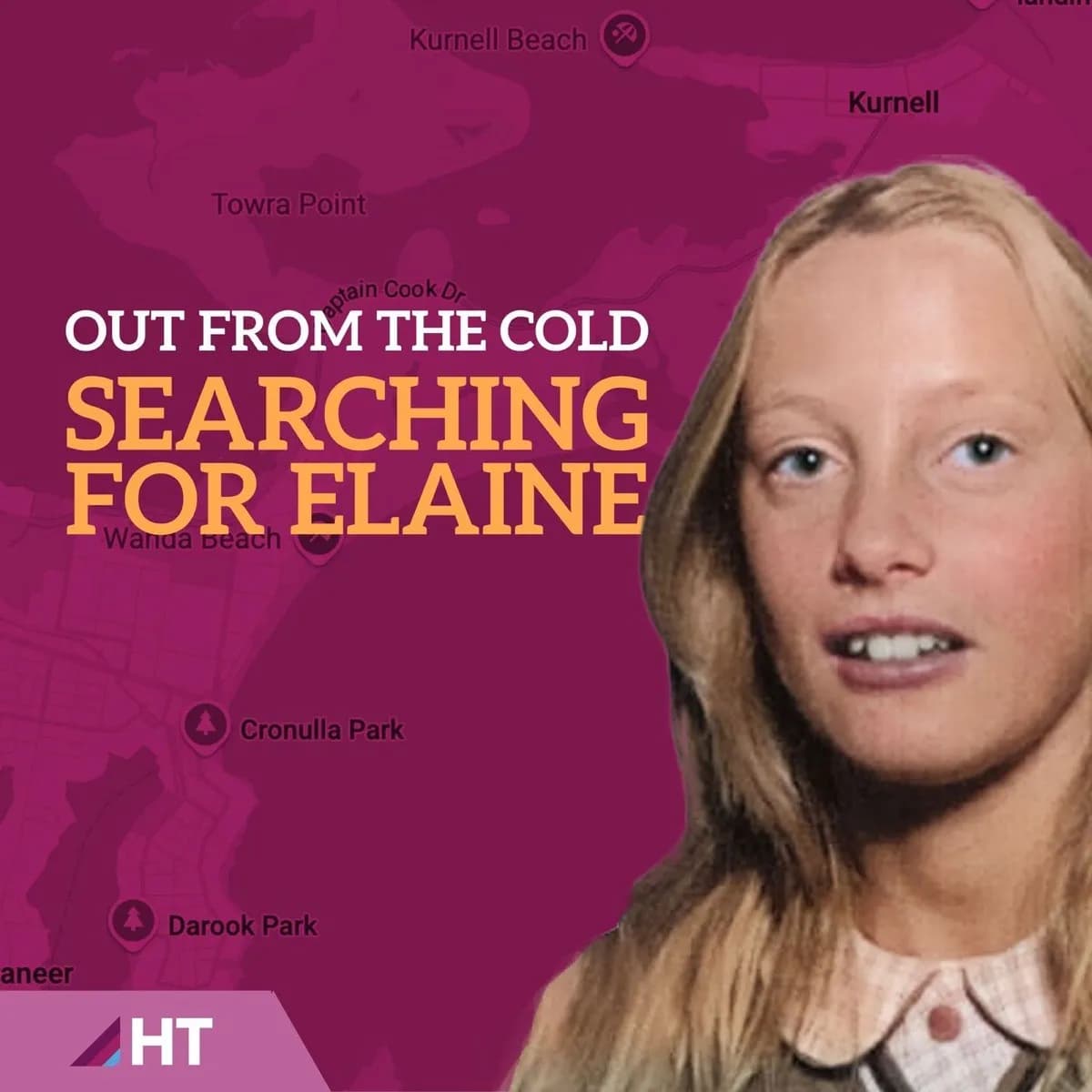
Investigative journalist Kate Kachor has released a new podcast examining the unsolved disappearance of two Australian teenage girls — Elaine Johnson, 17, and Kerry Joel, 18 — who vanished without a trace from Cronulla, a coastal suburb south of Sydney, on 1 February 1980. The podcast, Out from the Cold: Searching for Elaine, reopens a case that has gone unresolved for more than 46 years, with no arrests and no prosecutions ever made.
A Disappearance That Was Never Solved
On the evening of 1 February 1980, Elaine Johnson and Kerry Joel disappeared from Cronulla in New South Wales. The two friends were never found, and to this day no one has been charged in connection with their disappearance. Among followers of Australian cold cases, the case is regarded as one of the country's most persistent and haunting unsolved mysteries.
The families of the two girls have lived with uncertainty for decades. What exactly happened that February night has never been established with any certainty — and the case has never resulted in an arrest, let alone a conviction.
Two Years of Research Behind the Podcast
According to the podcast's own materials, Kate Kachor spent two years researching the case from the ground up. She tracked down family members, reviewed historical documents, and spoke with witnesses who had allegedly never spoken publicly about the case before.
From the outset, the goal was to give Elaine Johnson and Kerry Joel a voice — and to bring renewed attention to a case the Australian justice system has yet to resolve. Kachor emphasises an investigative approach over a purely narrative one: she positions herself not merely as a storyteller, but as an active investigator.
This is an approach that investigative true crime journalism has embraced globally in recent years — most notably following the success of podcasts like Serial, which demonstrated that rigorous journalism could breathe new life into cold cases and even influence their outcomes.
Cronulla in 1980 — Context for the Case
Cronulla is perhaps best known internationally for the violent race riots that erupted there in 2005, but in 1980 it was a quiet, relatively unremarkable coastal community. That two young women could vanish without a trace from such a setting is, according to Kachor, central to the podcast's broader argument: that society at the time did not adequately protect its young women, and that police resources dedicated to such cases were severely limited.
The disappearance draws comparisons to other unsolved disappearance cases from the same era — and fits into a wider pattern of unresolved cases from the 1970s and 1980s in New South Wales that Australian authorities have periodically attempted to reopen.
Why Cold Case Podcasts Continue to Hit Home
Cold case podcasts backed by genuine investigative journalism remain one of the fastest-growing formats within the true crime genre worldwide. Audiences are increasingly demanding not just entertainment, but credible, accountable journalism — and Out from the Cold: Searching for Elaine positions itself firmly in that space, combining first-hand interviews with historical documentation.
For international true crime audiences, unsolved cases from the 1970s and 1980s represent a particularly compelling genre: remote enough to feel historical, yet recent enough that witnesses, family members, and potential leads may still exist. Kachor's podcast is a testament to the fact that decades-old cases can still generate new attention — and potentially new information — when the journalism is thorough enough.
The case of Elaine Johnson and Kerry Joel remains open. No one has been convicted. No one has been charged. And two families are still waiting for answers.