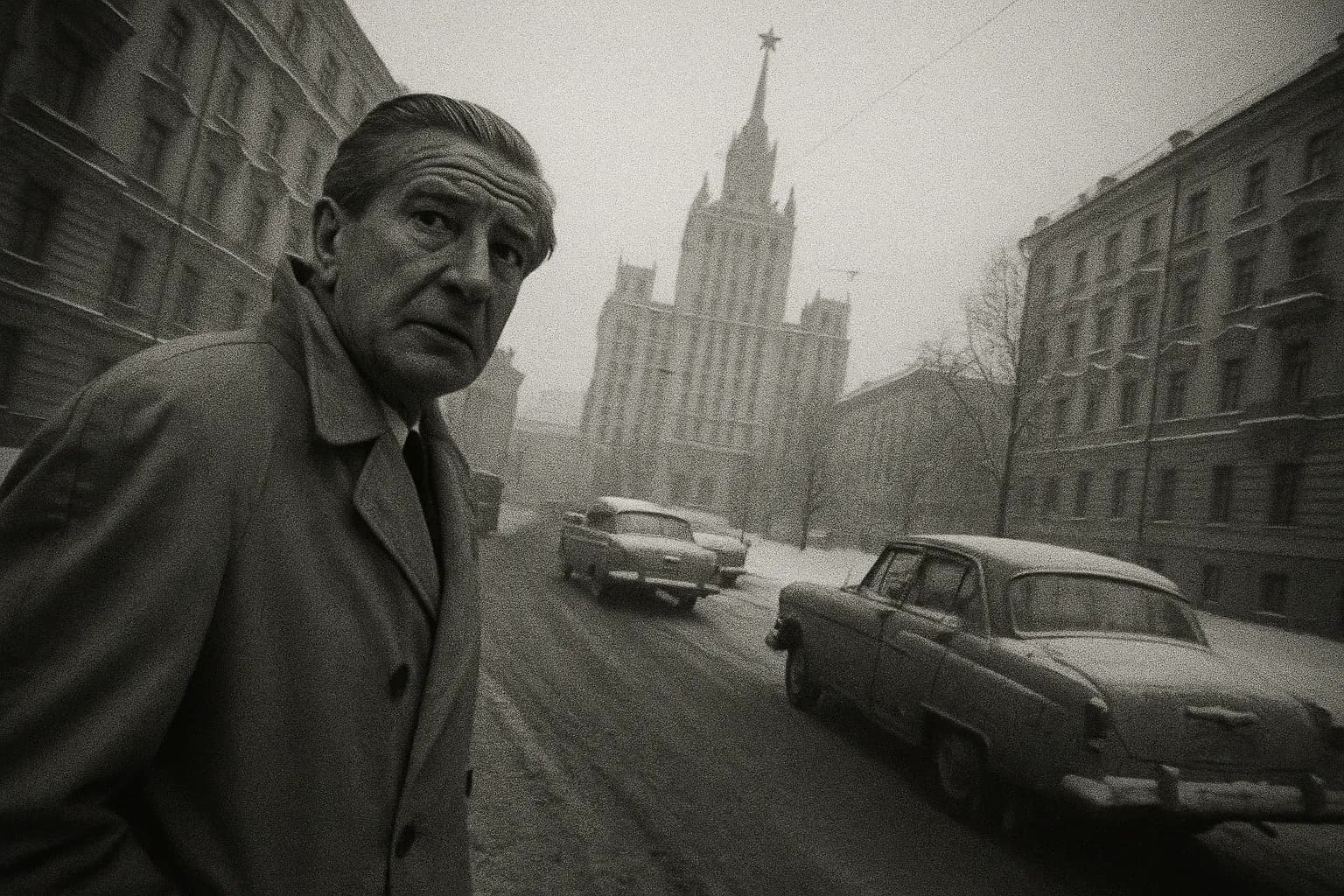
KGB
Soviet intelligence and security service, 1954–1991, dissolved with the Soviet Union
KGB (Russian: Komitet gosudarstvennoy bezopasnosti, the Committee for State Security) was the Soviet Union's state intelligence and security service, operating from 1954 until the dissolution of the Soviet Union in 1991 — an organisation with no basis in Danish law, but of far-reaching international significance as an actor in cross-border espionage and state security. It was not an institution of international law, but a state service acting on behalf of the Communist Party and the Soviet state, described in its own time as the party's 'sword and shield'.
The tasks of the KGB were threefold: foreign intelligence directed at other states and their institutions, counter-intelligence aimed at neutralising Western intelligence operations on Soviet territory, and internal security and political surveillance of the Soviet population and the state's borders. It was this combination of outward-facing espionage and inward-facing repression that made the KGB a central instrument of power in Cold War geopolitics.
In a true-crime context, the KGB appears above all as the institution that recruited, financed and directed foreign agents and double agents in the West. Cases such as Kim Philby — the senior British intelligence officer who worked for Moscow for decades — and John Walker Jr. — the US Navy officer who sold cryptographic secrets to the KGB — illustrate how the organisation systematically infiltrated Western security systems by recruiting individuals with access to classified information.
Under international law, the activities of the KGB raise questions of state responsibility and violation of other states' sovereignty, since espionage operations by definition took place without the consent of the host nations and often contrary to diplomatic norms. Although espionage has historically occupied a grey zone in international law, the work of the KGB was closely connected to questions of diplomatic protection and the attribution to a state of unlawful acts committed abroad.
After the fall of the Soviet Union in 1991, the KGB was formally dissolved and succeeded by several separate Russian services, of which the FSB (the Federal Security Service) and the SVR (the Foreign Intelligence Service) are the most prominent successors. Today the KGB exists solely as a historical designation, but it remains in use in legal and criminological accounts as a precise reference to the institution behind a number of the Cold War's most widely discussed espionage cases.