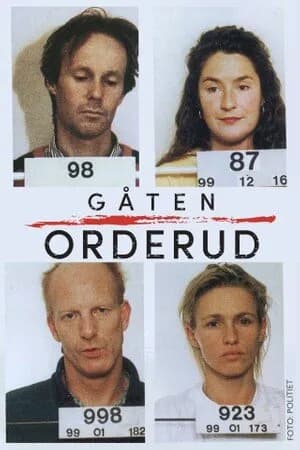
Gåten Orderud
NRK TV, 2018 — Norway's most infamous unsolved triple murder mystery
Fakten
What Is the Series About?
Gåten Orderud — translated loosely as The Orderud Enigma — is a three-part documentary series produced by NRK and broadcast on NRK1 from 28 October 2018. It revisits the Orderud case (Orderud-saken), a triple murder from 22 May 1999 that remains one of the most haunting and debated criminal cases in Norwegian legal history. Four people were ultimately convicted of complicity in the murders — but the identity of the person who actually pulled the trigger has never been established, and no weapon was ever recovered. The series sets out to examine how such a dramatic crime could leave that central question permanently unanswered.
The Case
In the early hours of 22 May 1999, three members of the Orderud family were found shot dead on the veranda of their estate in Sørum, Akershus, southeast of Oslo. The victims were Kristian Orderud, 81, his wife Marie Orderud, 84, and their daughter Anne Orderud Paust, 47. All three had been killed execution-style. There were no witnesses, and the crime scene offered limited forensic leads. Norway woke up to news of a killing that felt almost cinematic in its cold precision — carried out at a remote rural estate, against an elderly couple and their middle-aged daughter, by unknown assailants who vanished without a trace.
Investigators quickly focused on the family's internal dynamics. According to the Wikipedia article on the Orderud case, the prosecution's central theory was that the murders were motivated by a bitter dispute over ownership of the Orderud estate and farm. Per Kristian Orderud — Anne's brother and son of Kristian and Marie — and his wife Veronica Orderud were seen as having the clearest motive: securing full inheritance of the property. Veronica's half-sister, Kristin Kirkemo Haukeland, and Kristin's former partner, Lars Grønnerød, were alleged to have played supporting roles in organizing and facilitating the attack.
All four were arrested in June 1999. The trial, held in 2000, gripped the country. On 22 June 2001, the court delivered its verdicts: Per Kristian Orderud, Veronica Orderud, and Kristin Kirkemo Haukeland were each sentenced to 21 years — the maximum available under Norwegian law at the time. Lars Grønnerød was initially convicted only on illegal weapons charges, but his sentence was later revised upward to 18 years for complicity in the murders. Kristin Kirkemo Haukeland's sentence was subsequently reduced to 16 years on appeal.
Despite four convictions, the case carries a gaping hole at its center: no one was ever convicted of firing the shots. The actual shooter — or shooters — remain unidentified. The murder weapons were never found. All four convicted individuals have since been released after serving their sentences, and the case has not been officially reopened.
Production
Gåten Orderud was produced by NRK Documentary, the factual programming arm of Norway's public broadcaster. The series spans three episodes and carries a 15+ age rating, reflecting the gravity and detail of the material. No director is credited in widely available public sources, consistent with NRK's practice of attributing such productions to its documentary unit rather than individual filmmakers.
The series draws on archival footage, court records, and interviews to reconstruct both the crime and the investigation. It benefits from the passage of nearly two decades since the murders, allowing for a more reflective examination of what was known, what was proven, and what remains shrouded in uncertainty. The Evidence Locker Podcast episode on the Orderud murders notes the enduring fascination with the case among crime researchers, underscoring the cultural weight NRK was working with in producing this series.
The documentary does not claim to solve the case. Its title — Gåten, meaning the riddle or the enigma — signals its intent from the outset: to illuminate the mystery, not resolve it. It traces the arc from the discovery of the bodies through the arrests, the courtroom drama, and the legal aftermath, while consistently returning to the question that Norwegian society has never been able to answer with certainty.
Reception
Gåten Orderud holds an IMDb rating of 7.6 out of 10, reflecting a strong response from viewers who engaged with its subject. The series was described in Norwegian media as shedding new light on a murder mystery that had long been discussed but never fully understood by the general public. Viewers praised it for its structured approach to a genuinely complex case involving multiple defendants, contested motives, and unresolved forensic questions.
Public reaction upon broadcast centered heavily on the unsolved identity of the shooter — a detail the series foregrounds rather than minimizes. For many Norwegian viewers, Gåten Orderud served as both a reminder and a reckoning: four people were imprisoned for up to 21 years for a crime whose most fundamental element — who physically carried it out — was never legally resolved. The series sparked renewed calls in online forums and public commentary for a case review, though no official action followed.
No major negative controversies surrounded the production itself. Critics and audiences alike treated it as a serious, responsible piece of documentary journalism rather than sensationalist true crime content.
The Case Today
All four individuals convicted of complicity in the Orderud murders have now been released. Per Kristian Orderud served his full 21-year sentence. Veronica Orderud, Kristin Kirkemo Haukeland, and Lars Grønnerød have similarly exhausted their appeals and completed their terms. The case has not been officially reopened by Norwegian authorities.
The identity of the actual shooter remains unknown as of today. No new forensic evidence has emerged. The murder weapons have never been recovered. The Orderud case thus sits in a rare and deeply uncomfortable category: a crime for which justice was delivered in part — complicity convicted, sentences served — but for which the core act of killing remains legally unattributed.
For Norwegian audiences, the case continues to represent something more than a cold case. It is a rupture in the idea that the justice system, even when functioning correctly, can always deliver complete truth. Gåten Orderud captures that rupture with clarity and restraint — and in doing so, ensures the case remains part of the national conversation. A YouTube trailer for the series gives a sense of the documentary's tone: measured, atmospheric, and deeply unsettled by what it cannot explain.