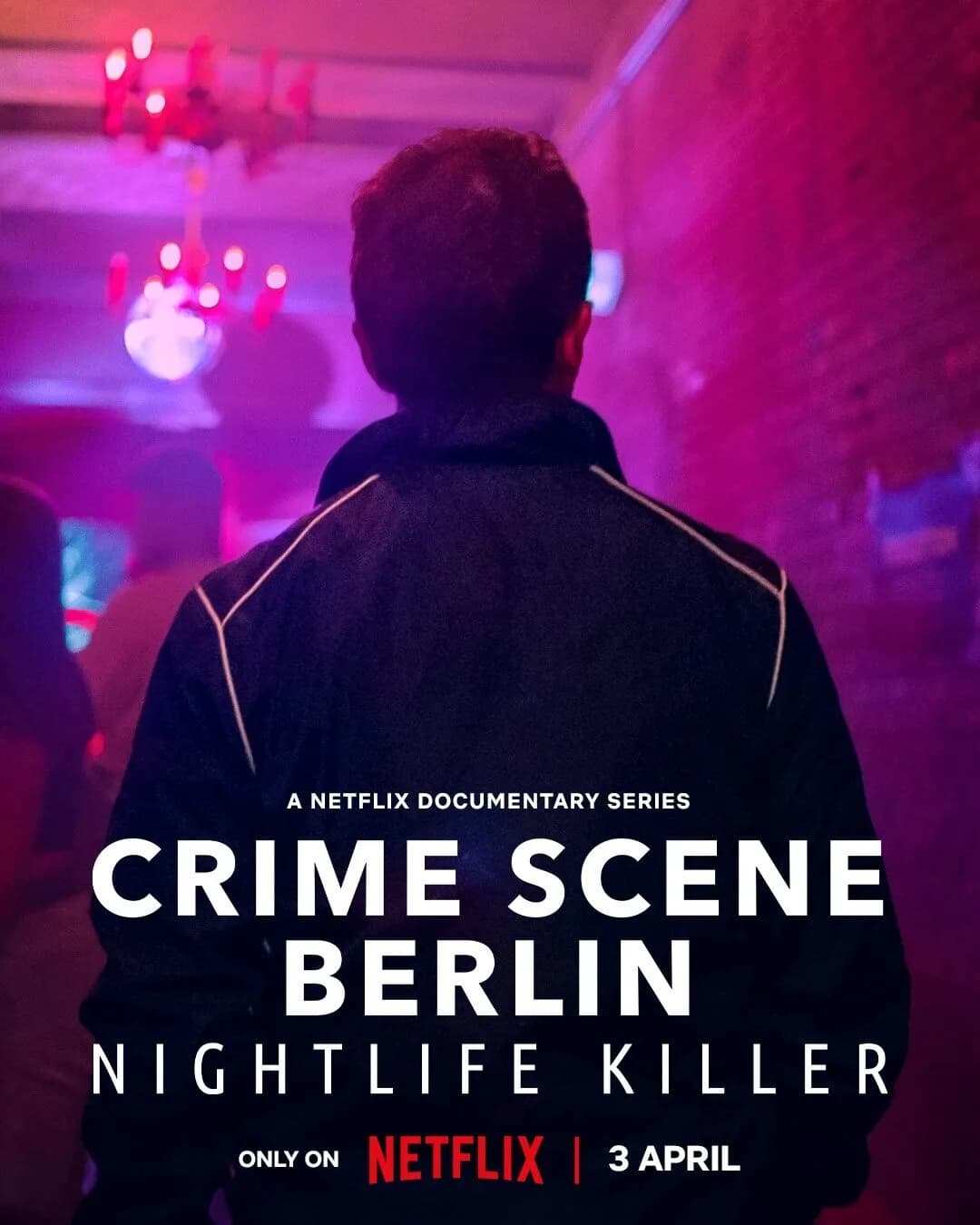
Crime Scene Berlin: Nightlife Killer
Netflix, 2024 — The real story of Berlin's GHB 'Coma Killer' who preyed on gay men in LGBTQ nightclubs
Fakten
What Is the Series About?
Crime Scene Berlin: Nightlife Killer is a three-part Netflix documentary series that reconstructs one of the most disturbing serial murder cases in modern German history — the 2012 "Coma Killer" spree (known in Germany as the Koma-Täter case), in which a man systematically drugged, robbed, and murdered gay men inside LGBTQ bars in Berlin's Friedrichshain district. Released globally on April 3, 2024, the series is the first international, non-U.S. entry in executive producer Joe Berlinger's acclaimed Crime Scene franchise on Netflix, and it marks a significant expansion of the brand into European true crime storytelling.
Each of the three episodes runs approximately 40 minutes, and the series is presented in German with English, Spanish, French, and other subtitle and audio options available. It carries a TV-MA rating for mature content, including depictions of drug use, sexual violence, and homicide.
---
The Case: Berlin's Coma Killer
In the spring of 2012, Berlin's vibrant LGBTQ nightlife community was shaken by a series of deaths that initially appeared disconnected. The first confirmed murder came to light on May 5, 2012, when the body of a gay man was discovered in the darkroom — an anonymous sex area — of an LGBTQ bar in Friedrichshain, a neighborhood long known as the beating heart of Berlin's queer and underground club culture.
Police initially struggled to link the deaths. The perpetrator, identified in German court proceedings only as Dennis N. due to Germany's strict privacy laws governing criminal proceedings, had developed a calculated and predatory method. He would approach vulnerable men inside LGBTQ bars, administer GHB (gamma-hydroxybutyrate) — a powerful central nervous system depressant commonly known as a "date rape drug" — into their drinks, wait for the victims to lose consciousness, rob them, and in at least three cases, allow them to die from the overdose or its complications.
At least three men were murdered and one victim survived the attacks. The murders all share a common thread: all victims were gay men who frequented Berlin's LGBTQ club scene, and all were incapacitated by GHB before being robbed and killed. The full names and ages of the murdered victims have not been disclosed in international media, in accordance with German law protecting the identities of homicide victims unless their families consent to disclosure.
The critical break in the case came when one surviving victim — whose identity also remains protected — managed to provide testimony to police after surviving a GHB poisoning. His account was instrumental in prompting investigators to reopen a case that had previously been closed, and forensic evidence linking the drug use, robberies, and murders ultimately led to the identification and arrest of Dennis N.
During the investigation, detectives uncovered what the series describes as a "dark past" for the perpetrator, including prior criminal behavior that had not previously connected him to the nightlife murders. A moment that puzzled many viewers of the documentary was the on-camera reaction of the killer's aunt, who initially claimed she did not know his whereabouts — a detail the series presents without full resolution.
Dennis N. was arrested, prosecuted, and ultimately convicted of multiple murders by a German court. He was sentenced to life imprisonment, the maximum penalty available under German law for serial homicide. As of the series' release in 2024, he remains incarcerated in a German prison.
---
Production
According to Variety, the series represents a deliberate effort by Netflix and Joe Berlinger to take the Crime Scene documentary brand global, following the success of U.S.-based entries such as Crime Scene: The Vanishing at the Cecil Hotel and Crime Scene: The Times Square Killer. Berlinger serves as executive producer, while the series was directed and created by Caroline Schaper, a German filmmaker whose local knowledge and access to German investigators and legal sources lends the production an authenticity that international co-productions sometimes lack.
The series was produced by Beetz Brothers Film Production, a Berlin-based production company with a strong track record in documentary filmmaking. Shooting in and around Friedrichshain — the actual neighborhood where the crimes occurred — the production grounds the story in a specific sense of place, capturing the neon-lit, industrial aesthetic of Berlin's underground club scene.
The documentary incorporates interviews with investigators, legal experts, and individuals connected to the case, as well as forensic reconstructions. True to the Crime Scene format, it balances procedural detail with a broader examination of the social context in which the crimes occurred — specifically, how the relative anonymity of LGBTQ darkroom culture may have both enabled the killer and complicated the initial police response.
---
Reception
The series currently holds an IMDb rating of 5.8/10 based on approximately 1,600 user votes, suggesting a mixed but engaged audience response. Rotten Tomatoes lists it as a limited series, though no aggregated critics score has been published.
Reviewers at Heaven of Horror praised the series for its forensic detail, its German-language authenticity, and its respectful handling of a case that directly affected a marginalized community. The focus on Berlin's LGBTQ club culture — depicted with nuance rather than sensationalism — was highlighted as a particular strength.
Decider's review offered a more measured assessment, acknowledging the strong case material while noting that the three-episode format leaves some threads underdeveloped. Some viewers expressed frustration at the absence of victim names and fuller biographical detail — though as multiple reviewers noted, this is a legal and ethical requirement under German law, not an editorial choice.
No major public controversies have surrounded the series. It is broadly viewed as a factual, respectful reconstruction of the case rather than an exploitative retelling. Its status as the first non-U.S. Crime Scene installment has drawn attention from both true crime fans and documentary critics interested in how the franchise adapts to European legal and cultural norms.
---
The Case Today
Dennis N. remains imprisoned in Germany, serving his life sentence. The "Coma Killer" case is considered closed by German authorities, though it left a lasting mark on Berlin's LGBTQ community and prompted broader conversations about safety in nightlife spaces, the policing of darkroom environments, and the risks associated with GHB — a substance that remains both a recreational drug in club culture and a tool of predatory violence worldwide.
The Netflix series has introduced the case to an international audience that was largely unaware of the 2012 murders, and viewer discussions on platforms like Reddit suggest it continues to spark debate about how German privacy law shapes the way true crime stories can be told — and what is inevitably left unsaid.